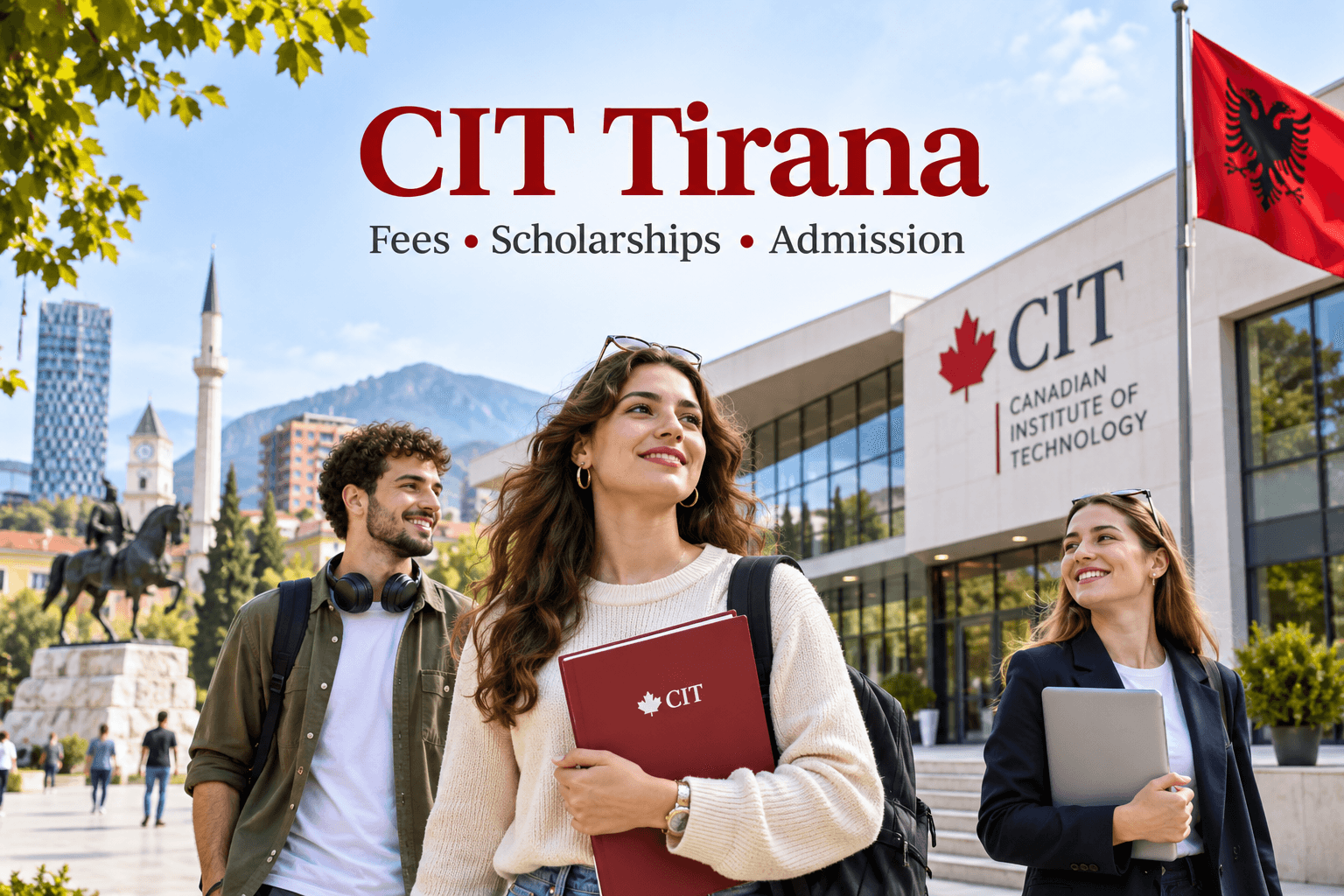
Explore studying at the Canadian Institute of Technology (CIT) in Tirana, Albania. Discover available programs, tuition fees for 2026–27, scholarships, admission requirements, and student life in this helpful guide for international students.
The Canadian Institute of Technology (CIT)** is a private, English-medium university college in Tirana, Albania, founded in 2011 and accredited by ASCAL, the Albanian Quality Assurance Agency. It focuses on software engineering, artificial intelligence, computer engineering, robotics, business and finance. International tuition is €3,000 to €3,500 a year, which makes CIT one of the more affordable ways to earn a European, ECTS-based tech degree taught in English.
Students and parents usually ask us two things about CIT. First, is it actually Canadian? Second, can it lead to a career in Europe? This guide answers both honestly, along with fees, scholarships, admission, housing and life in Tirana. We checked every figure against CIT's own pages and Albanian government sources before publishing, and we link to them so you can check them too.
What Is the Canadian Institute of Technology and Why Do Students Choose It?
CIT is an Albanian private university college, licensed by Decision of the Council of Ministers No. 781 on 10 November 2011, with a licence for master's programmes added in 2012. Its curriculum is modelled on Canadian standards and its programmes are taught in English, but it is not a campus of a Canadian university. Your degree is an Albanian degree issued by CIT. We say this clearly because the name confuses many families.
Why students still choose it:
- Tech-focused programmes in English: software engineering, AI and data science, computer engineering, telecommunications, electronics and robotics, alongside business and fintech.
- Low tuition for Europe: €3,000 to €3,500 a year for international students, with no application fee.
- Industry certifications on campus: CIT works with Cisco, EC-Council, AWS Academy, Oracle Academy, ACCA and PMI as an authorised training partner, which adds job-ready credentials to your degree.
- Experienced faculty: CIT reports that 60% of its academic staff hold PhDs or senior academic titles, and more than 1,000 students have graduated.
- European links: Erasmus+ mobility and partner universities in Germany, Italy, Portugal, Finland, France, Austria, Latvia and Turkey.
Canadian Institute of Technology at a Glance
| Key fact | Details |
|---|---|
| Official name | University College Canadian Institute of Technology (Kolegji Universitar Instituti Kanadez i Teknologjisë) |
| Type | Private university college, Albania |
| Founded | 10 November 2011 |
| Location | Xhura Complex, Rruga Xhanfize Keko No. 12, Porcelan, Tirana |
| Accreditation | Institutional accreditation by ASCAL (Albanian Quality Assurance Agency) |
| Faculties | Faculty of Engineering and Faculty of Economy |
| Language of instruction | English |
| Degree length | Bachelor's: 3 years (6 semesters) / Master's: 2 years (4 semesters) |
| Credit system | ECTS, under the European Bologna Process |
| Intakes | Fall and Spring semesters, applications accepted all year |
| International tuition | €3,000 to €3,500 a year |
| Official website | cit.edu.al |
Canadian Institute of Technology Programs for International Students
CIT runs 15 bachelor's and master's programmes across two faculties. You can see the full list on the CIT academics page.
Bachelor's Programs
| Field | Bachelor's programmes |
|---|---|
| Software and IT | Software Engineering; Artificial Intelligence and Data Science; Computer Engineering and IT |
| Electronics and robotics | Telecommunication Engineering; Electronics Engineering; Robotics and Mechatronics Engineering |
| Business and finance | Business Administration (Business Analytics or Digital Marketing); Finance and Accounting (International Finance and Economics or Fintech and Investment); Business Administration and Information Technology |
Master's Programs
| Field | Master's programmes |
|---|---|
| Software and IT | Software Engineering; Computer Engineering and IT (Network and Cyber Security, Computer Engineering and Big Data, or Multimedia Design); Artificial Intelligence |
| Business and finance | Business Administration; Finance and Accounting (Finance and Banking or Accounting and Auditing); Business Information Technology; Digital Marketing |
For most of our students, the strongest fits are Software Engineering, AI and Data Science, and Business Administration and IT. These match what employers in Tirana's growing IT and outsourcing sector hire for, and they transfer well if you plan a master's elsewhere in Europe later.
Canadian Institute of Technology Fees for International Students
CIT sets fees by faculty and study level, not by individual programme. Its Board of Administration approves fees at the start of each academic year. These are the current published fees for international students:
| Programme | International tuition per year | Albanian students (for reference) |
|---|---|---|
| Engineering bachelor's | €3,500 | €3,000 |
| Economy and business bachelor's | €3,000 | €2,500 |
| Engineering master's | €3,500 | €3,000 |
| Economy and business master's | €3,500 | €3,000 |
Other University Fees You Should Know
- Application fee: none. CIT states that applying is free for domestic and international students.
- Registration fee: €500 for international students, non-refundable.
- Repeat course fee: €250 per course at bachelor's level and €300 at master's level, only if you need to retake a course.
- Make-up exam: €50.
- What tuition includes: registration, transcripts, the student card, online books and insurance cover up to €2,000.
- Payment plan: tuition is paid in two instalments, the first within the first two weeks of the first semester and the second before first term exams.
Full details are on the CIT tuition fees page. On top of university fees, plan for your Albanian visa, residence permit, biometric card, document translation and living costs.
Canadian Institute of Technology Scholarships
CIT offers merit scholarships based on your GPA (on Albania's 10-point scale), competition results and social need. The GPA discounts are:
| GPA | Tuition discount |
|---|---|
| 10.00 | 100% |
| 9.8 to 9.9 | 75% |
| 9.5 to 9.7 | 50% |
| 9.0 to 9.4 | 25% |
| 8.5 to 8.9 | 15% |
Competition scholarships give 75% for first place, 50% for second place and 30% for third place. Scholarship holders may be asked to help with academic, administrative or cultural work at CIT. Read the conditions on the CIT scholarships page.
One honest note: the scholarship page does not say whether international students are eligible, and Indian or Gulf marks have to be converted to Albania's 10-point scale. Our counsellors confirm your eligibility and converted GPA with CIT before you pay anything, so you know your real tuition from day one.
Eligibility and Documents for CIT Admission
CIT publishes its admission criteria every year on its admissions page. As a general guide for Indian and Gulf students:
- Bachelor's: completed Class XII or equivalent.
In our counselling, we use 65% in Class XII as a safe benchmark, and stronger marks also help with the GPA scholarship.
- Master's: a recognised bachelor's degree in a related field.
- English: all teaching is in English, and you need proof of English ability for both admission and the residence permit.
- Diploma equivalency: foreign school and university certificates go through recognition with Albania's Ministry of Education after admission.
Documents Checklist
- Valid passport
- Class X and XII mark sheets and certificates (plus degree and transcripts for master's)
- Proof of English (IELTS, a similar test, or an English-medium school certificate where accepted)
- Passport-size photographs
- Apostilled or legalised academic documents with certified Albanian translations
- Proof of funds and accommodation for the residence permit
How to Apply to the Canadian Institute of Technology: Step by Step
- Choose your programme and intake. Pick Fall or Spring and check the current admission criteria.
- Submit the online application. Apply through
CIT's Apply Now page. There is no application fee.
- Receive your admission letter. CIT's admissions team reviews your file and confirms your place and any scholarship.
- Register and pay the first instalment. Pay the registration fee and plan the two tuition instalments.
- Apply for your Type D student visa. Indian nationals, including those living in the Gulf, apply online through the official Albania e-Visa portal before travel.
- Travel and apply for your residence permit.
Within 30 days of arriving, apply for the study residence permit on e-Albania, then collect your biometric card at the local migration office.
UniWhereCity counsellors guide students through every step, from programme selection and document preparation to the visa file, the residence permit and arrival in Tirana. You can book a free pre-counselling session to check your eligibility first.
Albania Student Visa and Residence Permit
Albania's rules for international students come from Law No. 79/2021 on Foreigners and its implementing decisions. Any stay longer than 90 days needs a residence permit.
- Before travel: apply for a Type D (long-stay) study visa through e-visa.al. The visa decision is made by the Albanian immigration authorities, not by CIT.
- After arrival: apply for the study residence permit on e-Albania within 30 days of entering Albania.
- Proof of funds: the official benchmark is a bank deposit in Albania of at least 300,000 lekë per person for one year, or another accepted form of proof.
- Biometric card: once your permit is approved, you visit the local migration office to give fingerprints and collect your residence card.
You can read the law itself in the English text of Law No. 79/2021 on Foreigners published by Albania's Ministry of Interior.
UniWhereCity Hostel and Accommodation Support in Tirana
CIT does not list its own dormitory on its website, so most international students live in shared flats or student residences in Tirana. UniWhereCity already runs its own student hostels in Egypt, and we apply the same standards when we set up housing for students in Tirana:
- Verified student housing: safe, checked flats and shared apartments within easy reach of the CIT campus in Porcelan.
- Indian meal support: homely Indian meal arrangements on request, so food is one less thing to worry about.
- Airport pickup: someone meets you at Tirana
International Airport and takes you to your room.
- Pre-departure briefing: what to pack, what documents to carry and what the first week looks like.
- Local help: a contact in Tirana for housing questions during your first months.
Cost of Living in Tirana
Tirana is one of the most affordable capital cities in Europe. Most of our students spend around €250 to €350 a month on a shared room, food, local transport and phone, and more if they choose a private studio. CIT is a short distance from the city centre, so most students walk or take a city bus instead of paying for long commutes.
Student Life and Part-Time Work in Tirana
Tirana is young, safe and easy to live in, with cafés, parks and a growing tech scene. CIT has an International Students Club, where Albanian students help newcomers settle in, and its International Relations Office supports orientation and adjustment.
On work, set realistic expectations. International students on a study permit may work up to 15 hours a week outside study time after their first year, and the employer must report the job through the tax system. Common roles are IT support, hospitality and customer service. Part-time income helps with daily costs, but your tuition plan should never depend on it.
Career Pathways After CIT: Albania and Europe
After graduating, Albanian law lets students apply for a residence permit to look for work or start a business. Under the updated permit rules, this job search permit runs for up to one year and can be renewed once for six months. Tirana's IT and outsourcing companies regularly hire English-speaking software and business graduates.
For Europe, be clear about what is and is not possible. Albania is an EU candidate country, but it is not in the EU or the Schengen area, so an Albanian residence permit does not let you work in Germany or Italy. What CIT does give you is an ECTS-based degree, Erasmus+ exchange opportunities and partner universities across Europe. Many students use this as a stepping stone to a master's degree in the EU, which then opens EU job routes. Each country recognises foreign degrees and issues work visas under its own rules, so plan that step early with your counsellor.
CIT or Another University in Albania?
If you are comparing options in Albania, read our guides to Epoka University in Tirana and Ismail Qemali University in Vlora. If you want a British degree in Europe instead, see our guide to studying in Greece at Metropolitan College. You can also explore every destination on our study abroad page.
Is the Canadian Institute of Technology the Right Choice for You?
CIT is a good fit if you want an English-taught tech or business degree in Europe at a low cost, value industry certifications and practical teaching, and are comfortable building your career in Albania first or moving on to an EU master's later. It is not the right choice if you are expecting a Canadian degree, or direct work rights in Germany or Italy straight after graduation.
Why Students Choose UniWhereCity
UniWhereCity is an overseas education consultancy with a regional desk at HiLITE Business Park, Kozhikode, and an office in Dubai. Families in Kerala can meet our study abroad consultants in Kozhikode, and students in the UAE can reach our education consultants in Dubai. Hear from students we have already helped on our Student Voices page, or read more about UniWhereCity.
Frequently Asked Questions About the Canadian Institute of Technology
Is the Canadian Institute of Technology a Canadian university?
No. The Canadian Institute of Technology (CIT) is a private university college in Tirana, Albania, founded in 2011. Its curriculum is modelled on Canadian standards and its programmes are taught in English, but your degree is an Albanian degree issued by CIT and accredited in Albania.
Is the Canadian Institute of Technology accredited?
Yes. CIT was licensed by the Albanian Council of Ministers in 2011 and holds institutional accreditation from ASCAL, the Albanian Quality Assurance Agency. CIT announced that it has been re-accredited for another five years.
What are the Canadian Institute of Technology fees for international students?
CIT's published tuition for international students is €3,500 a year for engineering bachelor's degrees, €3,000 a year for economy and business bachelor's degrees, and €3,500 a year for master's degrees in both faculties. There is also a €500 non-refundable registration fee for international students.
Does CIT offer scholarships?
Yes. CIT offers GPA-based merit scholarships from 15% for a GPA of 8.5 to 8.9, up to 100% for a perfect 10.00, plus competition-based and social scholarships. The scholarship page does not say whether international students qualify, so confirm your eligibility before you rely on it.
What courses does the Canadian Institute of Technology offer?
CIT offers bachelor's and master's programmes through its Faculty of Engineering and Faculty of Economy. Popular options include Software Engineering, Artificial Intelligence and Data Science, Computer Engineering and IT, Robotics and Mechatronics, Business Administration, Finance and Accounting, and Business Administration and Information Technology.
How long is a bachelor's degree at CIT?
A bachelor's degree at CIT takes a minimum of three years (six semesters) and a master's degree takes a minimum of two years (four semesters). Albania follows the European Bologna system, so degrees are built on ECTS credits.
Is there an application fee at CIT?
No. CIT states that applying is free for both domestic and international students. The fees start once you register: the €500 non-refundable registration fee for international students and your tuition, paid in two instalments.
Can international students work part-time in Albania?
Yes, with limits. Under Albania's rules, international students on a study residence permit can work up to 15 hours a week outside study time after their first year, and the employer must report the job through the tax system. Part-time work helps with daily costs but should not be counted on for tuition.
Can I stay in Albania after graduating from CIT?
Albanian law allows graduates to apply for a residence permit to look for a job or start a business after their studies. Under the updated permit rules, this job search permit can run for up to one year and can be renewed once for six months.
Does a CIT degree let me work in Germany or Italy?
Not automatically. Albania is not in the EU or Schengen area, so an Albanian residence permit does not give you work rights in Germany or Italy. Because CIT degrees use ECTS credits, they are easier to evaluate for a master's in Europe, but each country checks foreign degrees and work visas under its own rules.
Start Your CIT Application with UniWhereCity
If CIT is on your shortlist, talk to us before you apply. We will check your marks against CIT's criteria, confirm your scholarship chances, prepare your visa and residence permit file, and set up your housing in Tirana. Book your free pre-counselling session or call or WhatsApp us on +91 85929 96660.
References
- Canadian Institute of Technology: official website
- CIT: tuition fees
- CIT: scholarships
- CIT: admissions
- CIT: frequently asked questions
- [CIT: International
Relations Office](https://cit.edu.al/international-relations-office/)
- [ASCAL: Albanian Quality
Assurance Agency](https://ascal.al/)
No. 79/2021 on Foreigners (English)](https://mb.gov.al/wp-content/uploads/2024/10/Ligj-per-te-Huajt-%E2%80%93-nr.-79.2021_English.pdf)